


Team Building in the Age of AI: The One Skill Software Can't Automate
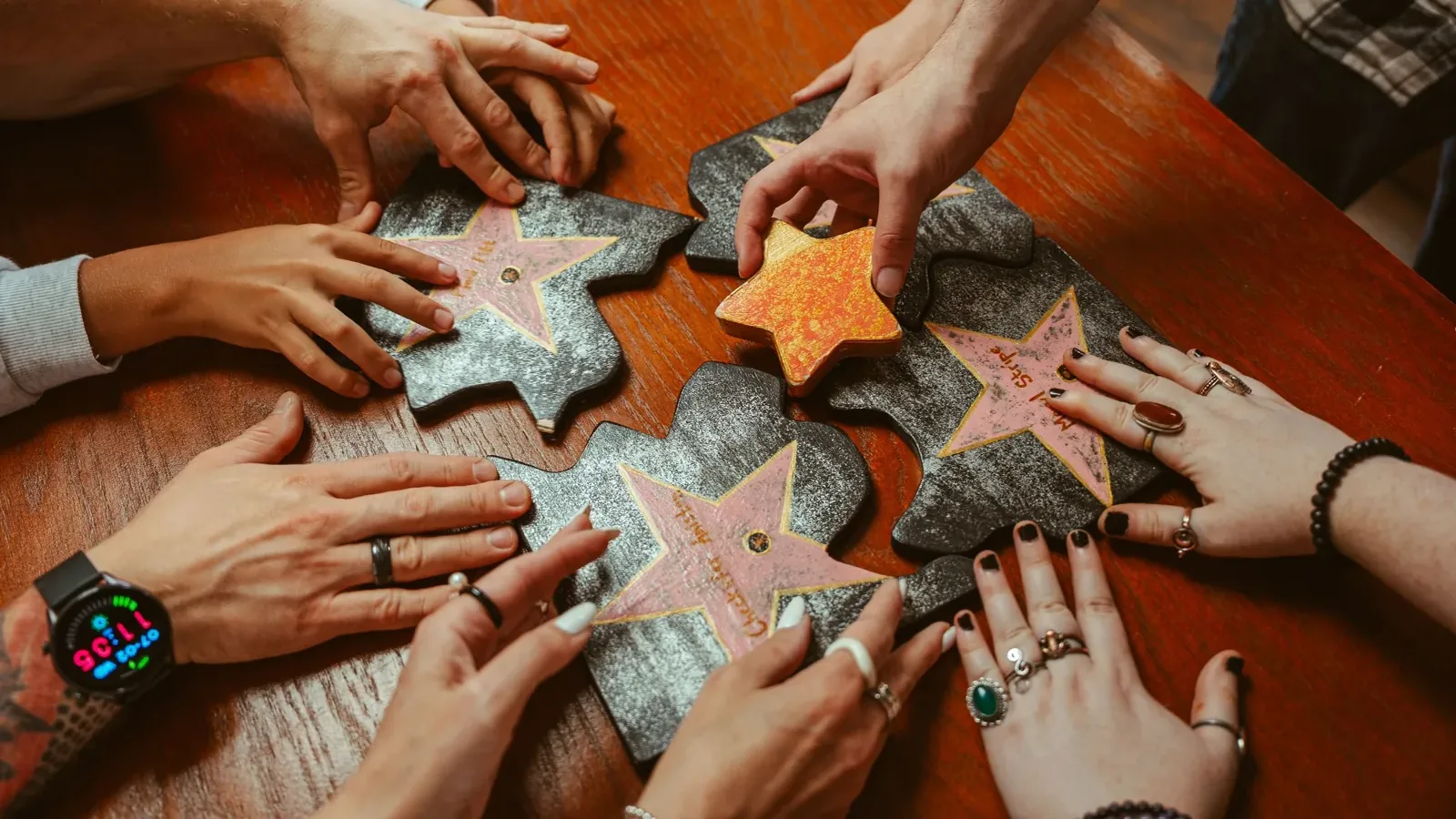
Quick answer: As AI takes on individual analytical tasks, one skill stays scarce: working things out with other people in real time, which means reading teammates, agreeing who does what and changing the plan together when the situation shifts. Escape rooms and free-roam VR put a team in front of a problem nobody has seen, on a clock, and that asks for exactly this. No event can promise to train it, but it is a good place to practise.
Walk into any leadership offsite in 2026 and you'll hear the same anxiety dressed up differently: what happens to our people when the AI does the analysis, the drafting, the first pass at everything?
The honest answer is that AI is very good at the parts of work a person can do alone. What it can't do is the part that happens between people, and that is the part many companies have stopped investing in.
Why does AI make team building more important, not less?
Because automation takes the individual tasks and leaves the collaborative ones. When the spreadsheet builds itself, the value moves to the conversation about what the spreadsheet means, who acts on it and how the team adjusts when the answer is ambiguous.
Gallup's 2026 State of the Global Workplace report is about engagement rather than AI, but it points at the same layer of the organization: manager engagement fell from 31% in 2022 to 22% in 2025, and global engagement fell to 20%. The people who orchestrate collaboration are less engaged than they were.
Source: Gallup, State of the Global Workplace 2026 (gallup.com).
What human skills can't be automated?
Four come up again and again, and none of them is learned from a manual:
- Judgment under ambiguity: deciding when the data is good enough to act on.
- Real-time communication: conveying the right thing to the right person while the clock runs.
- Role negotiation: figuring out who does what without a manager assigning it.
- Adaptive coordination: changing the plan together when the situation changes mid-task.
This is our own view of what AI leaves for people, not a finding from a study. But notice what the four have in common: they only appear when people face a genuine problem together that no individual could solve alone. You can't lecture them into existence. You have to create the conditions for them to surface.
Why do escape rooms and VR train these skills better than a workshop?
Because a workshop is performed and a real challenge is experienced. The research on team building (a meta-analysis of 60 correlations) found a positive, moderate effect overall, with goal setting and role clarification the components most associated with better team functioning.
Source: Klein, C. et al., "Does Team Building Work?", Small Group Research, 40(2), 2009 (doi.org/10.1177/1046496408328821). The study covers team building in general; it did not test escape rooms, VR or AI.
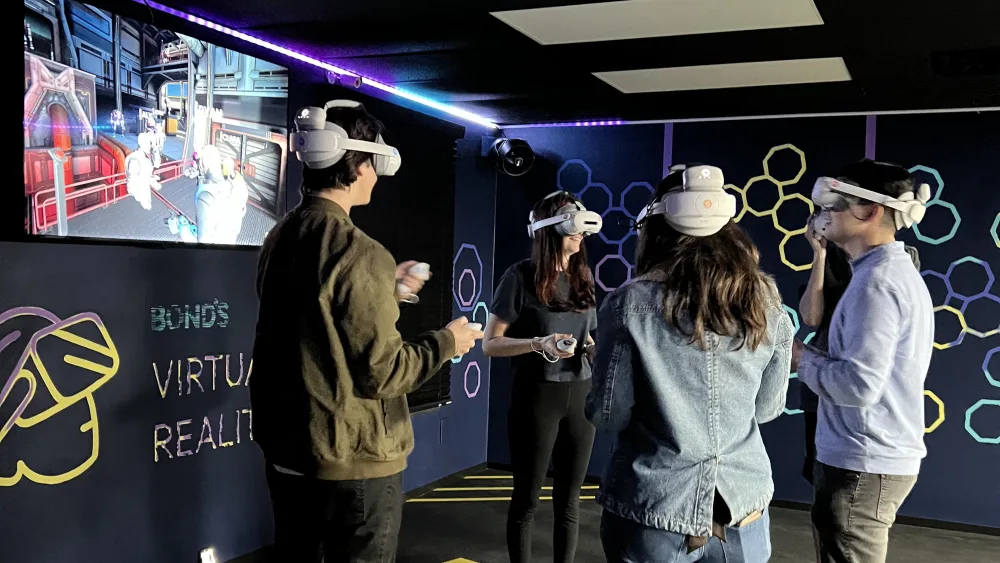
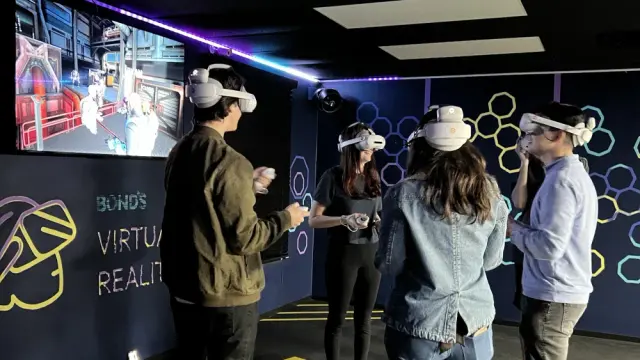
A 60-minute escape room is, structurally, a forced exercise in goal setting and role clarification under time pressure. The clues are spread around the room, so someone has to say what they are holding and someone has to listen. Bond's free-roam VR Arena works the same way: players walk through the game, run co-op missions together, and the headset puts everyone in an unfamiliar world on equal footing. Communication is the whole game.
What to expect when your team walks in
Every escape room is private, so it's only your colleagues in the room, and a game master watches and sends hints when a team asks. In Fairfax you can lean into the AI theme if you want a hook: 2233: Evil AI (3 to 7 players, advanced) has the team deactivate a self-aware AI, and 1960: History of the Future (3 to 7 players, intermediate) sends them back in time to stop a rogue one.
The VR Arena is $37 a person, runs about 60 minutes including gear-up, and is Fairfax only. Players pick co-op missions or head-to-head games and can switch or replay, so a mixed team can find a format that suits it. Afterwards, spend ten minutes on one question: where did we decide something without enough information, and how did we recover? The answer tends to transfer back to work better than the trophy.
For more on picking a format, see escape rooms vs VR vs game shows, our guide to the VR team building experience, and what we've written on employee engagement and team building and IT team building. The research behind it is in why immersive experiences build better teams, and booking is simpler than it sounds: see easy corporate team building in 2026.
Plan a team session
- Bond's Fairfax, 3949 University Dr, Fairfax, VA 22030. Nine escape rooms, two VR arenas, the Game Show and an on-site VIP conference space, minutes from I-66, Route 50 and George Mason University. (703) 270-0377.
- Bond's Arlington, 2800 Clarendon Blvd, Suite 910, Arlington, VA 22201. Six escape rooms, five minutes' walk from Clarendon Metro. (703) 884-1524.
Tell the events team how your team works day to day and what you want it to practise. Start with the team building event page: send the quote form with your headcount and date, or email info@bondsescaperoom.com. Groups run from 6 to 150, and packages start from $325 a team.
Questions people ask
Will AI replace the need for team building?
No, it raises the value of it. As AI absorbs individual analytical tasks, more of the work left to people is collaborative and judgment-based. Team building that makes a group coordinate under uncertainty gives people practice at the skills AI doesn't supply.
What human skills matter most in an AI workplace?
Judgment under ambiguity, real-time communication, role negotiation, and the ability to coordinate when the situation changes faster than any playbook. These are social skills that surface and develop through shared, unscripted challenge rather than through software training.
Are AI-themed team building activities worth it?
An AI theme can be a fun hook, but the durable value is whether the format forces real collaboration. A puzzle that demands coordination teaches more than an activity that is merely about AI. If you want the theme anyway, Bond's Fairfax has two escape rooms where an AI is the villain, 2233: Evil AI and 1960: History of the Future.
Where can companies near Tysons Corner or Reston run this kind of team building?
Bond's Fairfax has nine escape rooms, free-roam VR and the Game Show, and sits minutes from I-66 and Route 50. Arlington has six escape rooms and is five minutes from Clarendon Metro. Our guide to escape rooms near Tysons, McLean, Vienna and Reston covers the area in detail.
How much does a team session at Bond's cost?
Escape rooms are $34 a person, and VR and the Game Show are $37 a person. Team events for 6 to 150 people are quoted from $325 a team, depending on headcount, how many games each person plays and whether you add catering.
More stories
 Team Building
The Quiet Stayer Problem: Why Engagement Is Falling Even When Nobody Quits
Turnover looks healthy while engagement slips. What quiet stayers are, why surveys miss them, and what a shared challenge can show managers.
 Team Building
The VR Team Building Experience: How a Virtual Arena Shows You How Your Team Really Works
Free-roam VR team building at Bond's in Fairfax: two private arenas, up to 12 players at once, and a level playing field where nobody's job title helps.
 Team Building
IT Team Building Activities That Engineers Won't Roll Their Eyes At
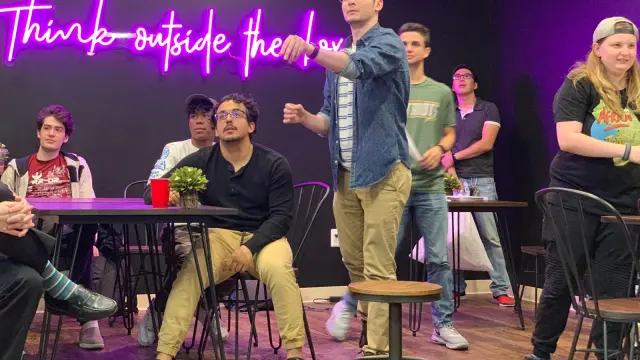
Why trust falls fail technical teams, and which formats work: escape rooms, free-roam VR and head-to-head games in Fairfax and Arlington, VA.