I've been in the escape room and corporate entertainment business for over a decade. And the question I get asked more than any other by HR leaders and People Ops professionals isn't "what's in your rooms" or "how much does it cost."
It's: "Does this actually work?"
It's a fair question. Team building has a credibility problem. Years of mandatory fun — trust falls, ropes courses, personality workshops that people forget by Friday — have made the entire category suspect. Smart HR professionals have been burned before, and they want evidence before they put their budget and their reputation behind another event. So let's talk about the evidence.
Why Traditional Team Building Doesn't Stick
The research on conventional team building is humbling. A meta-analysis published in Small Group Research examined 103 team building studies and found that while structured activities show short-term improvement in team cohesion, effects decay rapidly when the activity has no connection to how the team actually operates under pressure.
Source: Klein, C. et al., "Does Team Building Work?" Small Group Research, Vol. 40(2), 2009.
The problem is structural. Most traditional team building activities are performed, not experienced. People know they're being observed. They know there's a "right" behavior to model. So they model it — and then revert to their real behavioral patterns the moment the workshop ends.
You cannot build genuine team dynamics through performed behavior. You can only build them through authentic behavior under real conditions. This is the foundational insight behind experiential team building.
What Immersive Environments Actually Do to the Brain
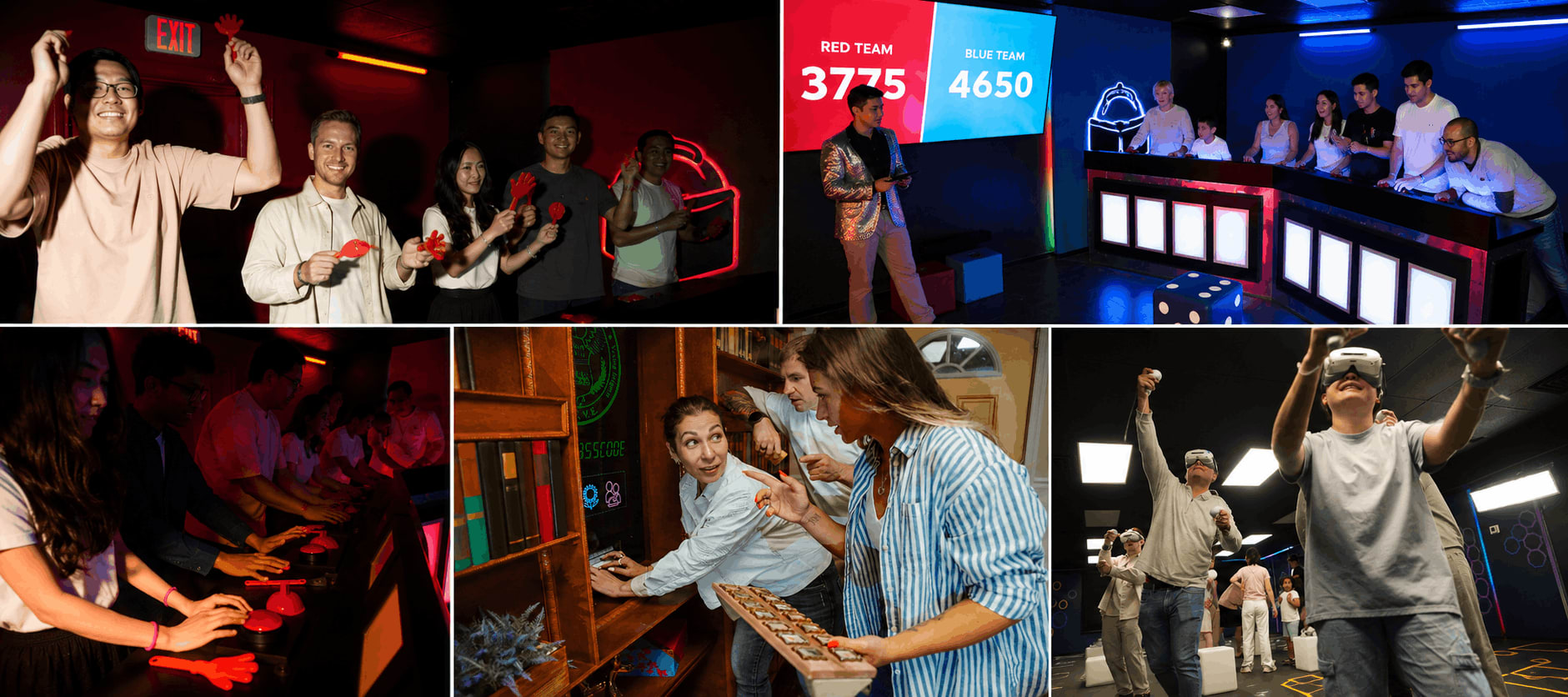
When you put someone in a genuinely novel, high-engagement environment — an escape room, a free-roam VR arena, a live competitive game show — several things happen that don't happen in a conference room.
Stress hormones activate authentic behavior
Mild stress — the kind produced by a 60-minute countdown clock or a competitive VR battle — engages the same decision-making instincts as real-stakes situations. People respond from their actual behavioral repertoire, not their performed one. Research on stress exposure training and team performance shows that groups trained under realistic pressure conditions perform measurably better when facing actual high-stakes situations.
Source: Driskell, J.E. & Johnston, J.H., "Stress Exposure Training," Making Decisions Under Stress, American Psychological Association, 1998.
Shared challenge builds trust and bonding
Trust and social bonding are driven not by proximity, but by shared experience — particularly shared challenge with uncertain outcomes. Teams that go through a genuinely difficult escape room together report feeling closer to their teammates than teams who completed a smooth, frictionless experience. The struggle is the point.
Source: Zak, P.J., "The Neuroscience of Trust," Harvard Business Review, January–February 2017.
Emotional activation strengthens long-term memory
Experiences that generate moderate emotional arousal — excitement, mild stress, competitive energy — are encoded in long-term memory more reliably than neutral experiences. This is the difference between a team building event people are still talking about three months later and one that's forgotten by Monday.
Source: McGaugh, J.L., "Memory — A Century of Consolidation," Science, Vol. 287, January 2000.
The Behavioral Data That Surfaces in Experiential Formats
Beyond the science, the practical value of experiential team building comes down to behavioral visibility. In a normal work environment, most employees operate within established social scripts. The hierarchy is clear. The roles are defined. Put those same people in an unfamiliar environment with genuine uncertainty — and the scripts disappear.
- Who leads under pressure without being asked — often not the most senior person, but the most instinctively effective one.
- Who communicates when the stakes feel real — escape room patterns often mirror how people communicate in a workplace crisis.
- Who elevates the team under stress — versus who contracts and goes solo.
- Who adapts when the rules change — a clean proxy for handling organizational change and ambiguity at work.
This is behavioral data that performance reviews don't capture, that 360 surveys only approximate, and that immersive, experiential team building surfaces directly — in a context where it's visible to the whole team.
What This Means for How You Plan Your Next Corporate Event
- The format matters more than the budget. A $50-per-person immersive experience that creates genuine challenge will outperform a $300-per-person passive workshop every time.
- The debrief is half the value. A structured debrief immediately after dramatically increases long-term behavioral transfer. Don't skip it.
- Frequency matters. Regular events — quarterly or twice-yearly — produce compounding cultural effects that show up in retention and productivity over time.
- The experience should be unfamiliar to everyone equally. Choose formats where seniority and institutional knowledge are irrelevant.
What We've Built at Bond's
Over ten years of running corporate team building events in Northern Virginia and the broader DC area, I've watched the science play out in real time — with hundreds of corporate groups, across every industry, at every company size.
The consistent result: teams that experience genuine challenge together come out the other side with something hard to manufacture any other way. A shared reference point. A new picture of who their colleagues actually are. A baseline of trust built under real pressure, not constructed in a workshop.
At Bond's Entertainment Center, we've built 15+ escape rooms, a free-roam VR arena, and a live customizable game show specifically to create these conditions — for groups of 10 to 150+, with private space, catering, and full coordination, across Fairfax and Arlington.
The science says immersive experiences build better teams. We built the venue to prove it.
Want to see the research translate into a real event for your team? Schedule a 15-minute planning call and we'll show you exactly how the science maps to your group.
📍 Fairfax & Arlington, VA | 📞 703-270-0377
🌐 Plan your team building event with Bond's