


The VR Team Building Experience: How a Virtual Arena Shows You How Your Team Really Works
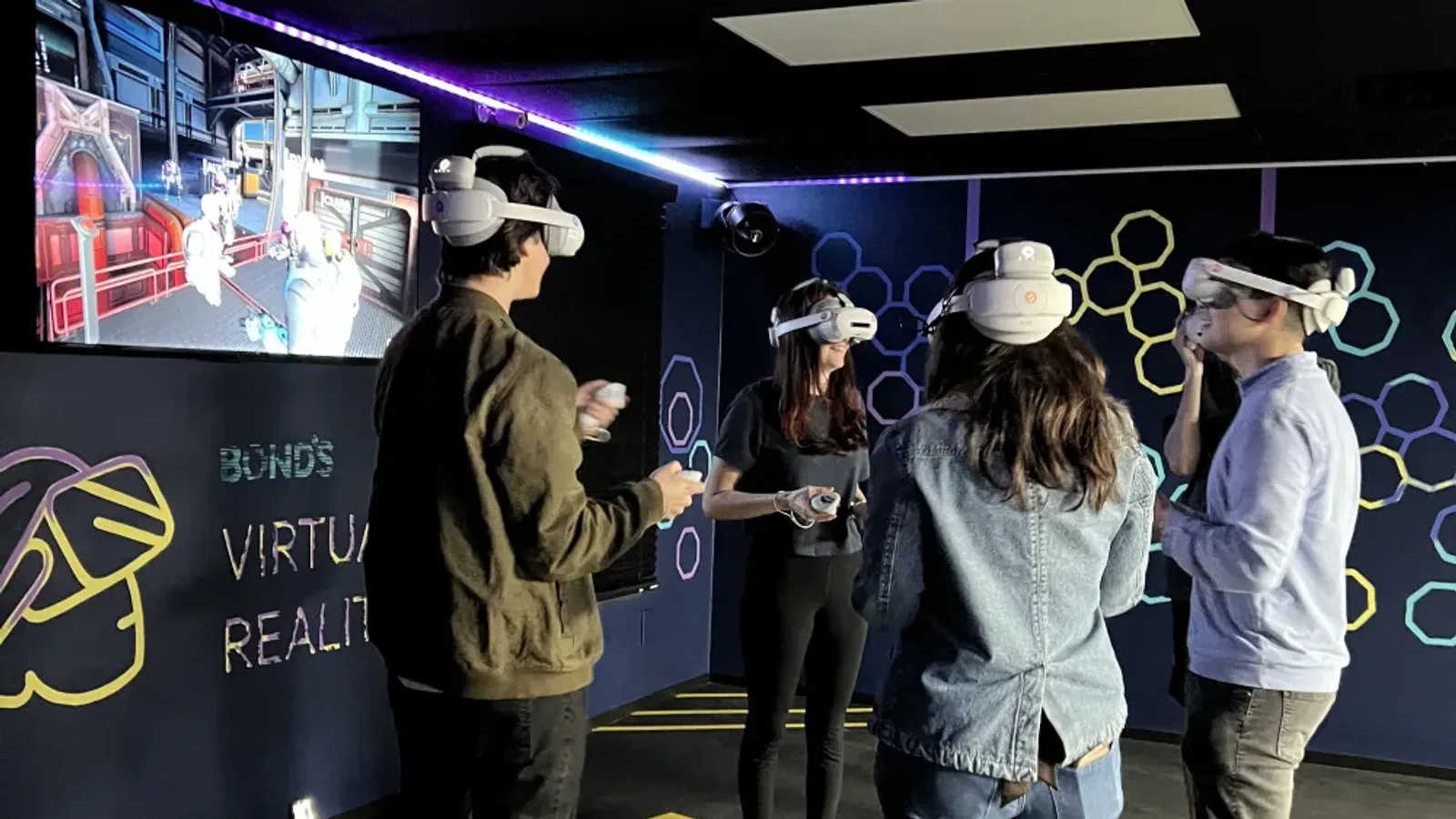
Quick answer: Free-roam VR team building puts a team in a shared virtual mission that they move through on foot. The space is new to everyone, so rank and tenure help no one, and how people coordinate, communicate and step up is easy to see. At Bond's it runs in Fairfax: two private arenas, up to 12 players at once, about an hour including gear-up.
Here is the problem with spotting leadership at work: the workplace is rigged. The org chart tells everyone who is in charge, the meeting has a script, and the senior person speaks first by default. Real instinct stays hidden under all that structure.
Free-roam VR takes the structure away. In the unfamiliarity, the thing you actually want to see, who steps up when nobody has been told to, gets much harder to miss.
What is free-roam VR team building, exactly?
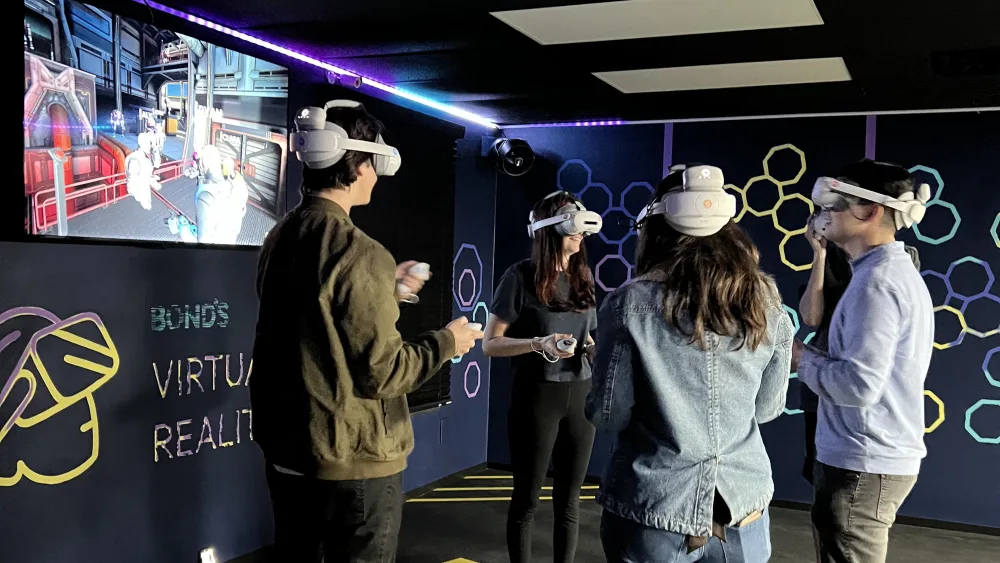
It is not headsets-at-your-desk VR. Free-roam means the team physically walks through a shared virtual space, a mission, an arena or a challenge, moving and talking in real space while the virtual world responds. At Bond's the headsets are wireless, with full-body motion tracking, and they are built to fit over most glasses. Nobody needs VR experience, and nobody sits on a couch holding a controller in their lap.
That physicality matters. The team has to coordinate as bodies in a room, not as avatars on a screen, so what people say out loud to each other matters as much as how well they aim.
Why can VR show you things a performance review doesn't?
Because it is a genuinely level playing field. No one has a home-field advantage. No one can fall back on title, tenure or reputation. The environment is equally strange to the CFO and the new hire, and in that equality real behavior patterns show up.
Watch for the signals. Who takes charge without being asked? Who communicates clearly under pressure? Who stays composed when the team is losing, and adapts? Who goes off alone when the game needs coordination? These are leadership and teamwork behaviors, and a co-op mission puts all of them on display in a short stretch of time.
Pressure plays a part too. Researchers who study stress exposure training, practising a task under realistic pressure, find that people cope better with the real thing afterwards (Driskell and Johnston, 1998). A timed, competitive mission is a safe, low-stakes cousin of that pressure, so people are more likely to act the way they normally do than the way they think they are expected to.
One honest caution: a VR session is a window, not a rating. Treat what you notice as the start of a conversation with your people, not a score for a promotion decision.
Where free-roam VR fits best
- High-potential employee programs, where you want a fresh read on how emerging leaders work with others.
- Post-merger or post-restructure events, where the existing hierarchy needs a reset.
- Teams where you want to see who is ready for more responsibility, as one input among several.
- High-energy groups who want real, physical competition.
Why the unfamiliarity is the whole point
Most team building accidentally recreates the existing hierarchy. The extrovert wins the social event, the athlete wins the physical one, the senior leader runs the structured one. The moment someone has an advantage, you are watching the org chart, not the team.
VR refuses to give anyone that advantage, and that connects to what the research looks at. A 2009 meta-analysis of team building studies (Klein and colleagues, 60 correlations) found a positive, moderate effect across team outcomes, strongest for affective outcomes (how people feel about the team) and process outcomes (how they work together). The four components it examined were goal setting, interpersonal relations, problem solving and role clarification. In a free-roam mission the team has to settle roles and goals from scratch, together, with no one's title to lean on.
What a session looks like at Bond's
Free-roam VR is in Bond's Fairfax only. Arlington has escape rooms and no VR. The details, from the VR Arena page:
- Group size: 2 to 6 players per arena, with two arenas running side by side, so up to 12 people can be in VR at the same time.
- Time: about 60 minutes from the moment you walk in. Gear-up and a short how-to come first. Each game runs about 10 to 15 minutes, so most groups play several and replay a favorite.
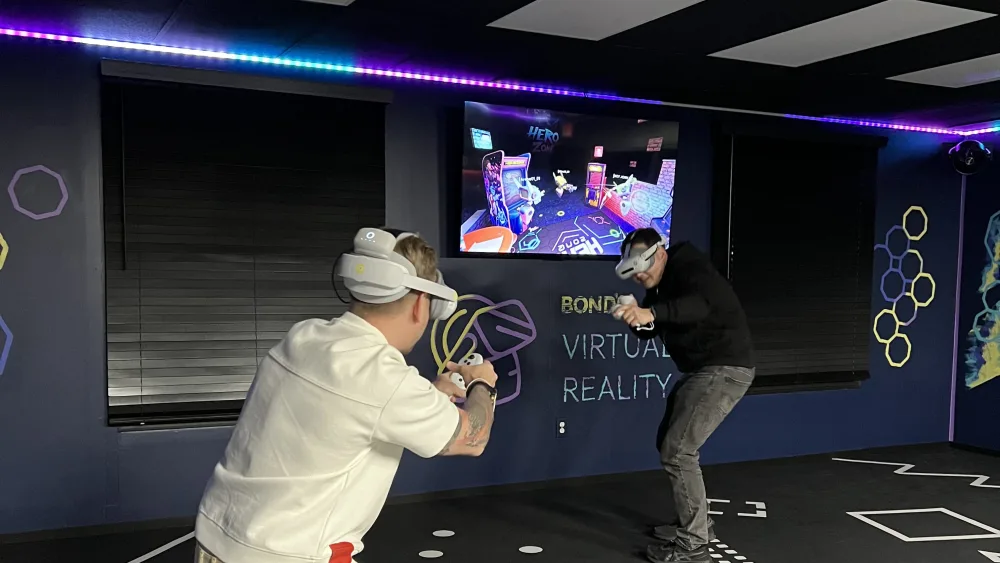
- Games: co-op missions such as Terminator Uprising and Dead Ahead, where the squad has to hold a line together; party games such as Cook'd Up and Plush Rush; and head-to-head PvP such as Quantum Arena for teams that would rather compete.
- Privacy: the session is always your group, with no strangers.
- Price and age: $37 a person on the public booking page, ages 8 and up, with adult supervision under 13. Team packages are quoted from $325 a team.
For a bigger group, run VR as one stop in a larger day. While one subgroup is in the arenas, others can be in the escape rooms or the Game Show, then you swap. If you are weighing the three formats, our guide to escape rooms vs. VR vs. game shows walks through which fits which goal. For escape-room-specific leadership signals, see using escape rooms to identify leaders, and for the reasons a survey often misses what a shared task shows, leadership identification activities and other things to watch instead.
New to all this planning? Start with the hub post on how easy corporate team building is in 2026.
Book VR for your team
VR is at Bond's Fairfax, 3949 University Dr, Fairfax, VA 22030, with free parking. Tell us the cohort you want to put in the arena, how many people and when, and we will plan it. Use the quote form on the team building page, call (703) 270-0377 or email info@bondsescaperoom.com. Asking costs nothing.
Questions people ask
What is free-roam VR team building?
Free-roam VR team building puts a team in a shared virtual space that they move through on foot, with wireless headsets and no controller tethering them to one spot, to complete missions together. Because the space is unfamiliar to everyone, it strips away titles and tenure and makes it easier to see how people coordinate under pressure.
Does VR team building work for people who get motion sick?
Bond's VR is free-roam, so players walk instead of steering with a joystick, which cuts down on the motion sickness that joystick-based VR can cause. The headsets fit over most glasses, and the crew walks every player through moving and aiming before the game starts. If someone on your team is worried, mention it when you request your quote.
What size group is VR team building best for?
Two arenas run side by side with 2 to 6 players in each, so up to 12 people can play at once. That suits a leadership cohort or a small department. Larger groups rotate through VR in waves while other subgroups play escape rooms or the Game Show.
Where can companies near Tysons Corner try VR team building?
Bond's VR Arena is in Fairfax, at 3949 University Dr, and serves teams from Tysons, Reston, Vienna and across Northern Virginia and DC. It is a drive from most offices. By Metro, the nearest rail is Vienna on the Orange Line, then the CUE bus, whose stop is about a five-minute walk from the door. Arlington does not have VR.
How much does VR team building cost at Bond's?
VR is $37 a person on the public booking page. Team packages are quoted from $325 a team, depending on group size, how many games each person plays and whether you add catering.
More stories
 Team Building
Escape Rooms vs. VR vs. Game Shows: Which Team Building Format Is Right for Your Company Goal
Escape rooms, VR, or a game show for your team building event? Match the format to your goal — at Bond's in Fairfax & Arlington, VA.
 Team Building
How Easy Corporate Team Building Is in 2026 (When You Use the Right Venue)
Planning corporate team building no longer means juggling vendors. How one venue with escape rooms, VR, a Game Show and catering turns it into one call.
 Team Building
Why Your Engagement Survey Is Lying to You (and What to Watch Instead)
Surveys are delayed, self-reported and averaged. What managers can watch for in a shared challenge, and how to use it without labelling anyone.