


Why Your Engagement Survey Is Lying to You (and What to Watch Instead)

Quick answer: Engagement surveys have three built-in limits: they only hear from people who answer, they arrive after the fact, and a company average hides the teams in trouble. A useful extra signal is observed behavior, meaning how people communicate, take a role and adapt when something changes. A shared, unfamiliar challenge makes some of that easy to see, as long as you treat it as one input and not a verdict.
Here's an uncomfortable thing to say as a business that benefits from engaged teams: the engagement survey, as most companies run it, tells you less than it looks like it does.
Not because the questions are wrong, but because of what a survey is, a delayed, self-reported snapshot, and what disengagement is: a gradual, often hidden drift in behavior.
Why are engagement surveys becoming unreliable?
Three limits are built in. A survey only reflects the people who answer, so a thin response thins the data. The feedback arrives late, because an annual or even quarterly cadence can't keep up with how fast sentiment moves. And organization-wide averages mask the teams in real trouble: a company can post healthy overall numbers while one team is already burned out.
Gallup put global engagement at 20% in 2025, the lowest since 2020. That doesn't prove surveys are broken, and it may be accurate bad news, but it is a reason to ask what else you're measuring.
Source: Gallup, State of the Global Workplace 2026 (gallup.com).
What's a better signal than a survey?
Behavior under real conditions. A survey asks a person to describe themselves; observation lets you see what they do. Behavior often tells you things self-description doesn't, especially about how someone leads, collaborates or handles change.
The team-building research points the same way. A meta-analysis of 60 correlations found a positive, moderate effect overall, strongest on affective and process outcomes, with goal setting and role clarification the components most associated with gains. Role clarification and goal setting are things you can watch a team do, not attitudes ticked on a five-point scale.
Source: Klein, C. et al., "Does Team Building Work?", Small Group Research, 40(2), 2009 (doi.org/10.1177/1046496408328821). The study covers team building in general, not escape rooms.
What behavior should managers actually watch for?
- Who takes a role without being assigned one, the instinctive coordinator your org chart never named.
- Who communicates clearly when the stakes feel real, and who goes silent.
- Who lifts the group under stress, and who contracts and works alone.
- Who adapts when the rules change mid-task, a rough proxy for handling organizational change.
Few of these show up in a normal meeting, where social scripts and hierarchy do the talking. They appear when the script is removed, which is the point of an unfamiliar, genuinely challenging environment.
Keep the limits in view. A game is a different setting from a quarterly review, someone quiet is not necessarily disengaged, and one hour can't rate a person. Tell the team beforehand that it's a team event, not an assessment, and use what you notice to ask better questions later.
What managers can see at Bond's
Bond's has hosted more than 9,000 team events over 11 years. Every one of the 15 escape rooms across Fairfax and Arlington is private, runs 60 minutes and costs $34 a person, and none is built for a lone hero: nobody finds every clue alone, so people have to say what they are holding and listen to what everyone else found. That forces role clarification in real time.
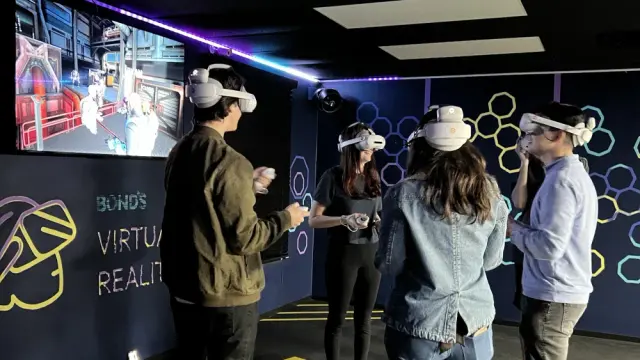
What you might see: the quiet analyst who spots the pattern the rest of the room missed, or the senior title who waits to be told what to do now that nobody is following a script. In our experience, the person who steps up to run the room is rarely who the org chart would predict. The VR Arena in Fairfax (co-op missions for 2 to 6 players per arena) draws out the same behaviors.
To be clear about the limits: Bond's runs the games, and that's all. It doesn't observe or score your people, and it doesn't hand back a report. Pair your survey with something that shows you what people do. For more on this, read about the quiet stayer problem, how escape rooms can show who leads, our guide to the VR team building experience, and team building in the age of AI. The wider research is in why immersive experiences build better teams, and the booking side is covered in easy corporate team building.

Plan a team session
- Bond's Fairfax, 3949 University Dr, Fairfax, VA 22030. Nine escape rooms, two VR arenas, the Game Show and an on-site VIP conference space for a debrief. (703) 270-0377.
- Bond's Arlington, 2800 Clarendon Blvd, Suite 910, Arlington, VA 22201. Six escape rooms, five minutes' walk from Clarendon Metro. (703) 884-1524.
Tell the events team the group and what you're trying to understand about it, and they will plan around it. Start with the team building event page: send the quote form with your headcount and date, or email info@bondsescaperoom.com. Groups run from 6 to 150, and packages start from $325 a team.
Questions people ask
What are good alternatives to employee engagement surveys?
The strongest alternatives capture behavior rather than self-report: structured manager observation, frequent short pulse check-ins, and what you can see in shared, high-involvement settings such as a team event, where you notice how people communicate and take roles. Use them alongside the survey, not as a replacement.
Why are annual engagement surveys no longer enough?
An annual survey captures a single moment, while disengagement builds gradually. By the time the yearly results arrive, the behavior they were meant to detect may already have cost you a project or a person.
Can you measure leadership potential without a survey?
You can watch for it. Behavior under genuine pressure tells you things a self-assessment can't: who steps up, who communicates clearly, who adapts when the rules change. A game is not a validated assessment, so treat what you see as a starting point for a conversation and not a rating.
How do companies in Northern Virginia gather behavioral insight on a team?
Many pair their survey program with a team event, such as escape rooms, VR or the Game Show, where managers can see how people work together. Bond's runs these for groups of 6 to 150 across Fairfax and Arlington, with VR and the Game Show in Fairfax only.
Does Bond's give managers a report on how their team behaved?
No. Bond's runs private games for your group and doesn't assess or score individuals. What managers notice during and after the event is theirs to use.
More stories
 Team Building
The Quiet Stayer Problem: Why Engagement Is Falling Even When Nobody Quits
Turnover looks healthy while engagement slips. What quiet stayers are, why surveys miss them, and what a shared challenge can show managers.
 Team Building
 in the Age of AI: The One Skill Software Can't Automate
As AI takes on solo tasks, working things out with other people matters more. How escape rooms and free-roam VR give teams practice at it.
 Team Building
The VR Team Building Experience: How a Virtual Arena Shows You How Your Team Really Works
Free-roam VR team building at Bond's in Fairfax: two private arenas, up to 12 players at once, and a level playing field where nobody's job title helps.