


IT Team Building Activities That Engineers Won't Roll Their Eyes At
Quick answer: IT and engineering teams tend to switch off at generic team building because forced fun feels arbitrary to analytical minds. They engage with puzzle- and systems-based formats, such as escape rooms, free-roam VR missions and head-to-head competitions, that present a real problem with real rules. Those reward the structured thinking technical teams already respect.
Ask an engineering manager about the last mandatory team building event and watch the micro-wince. It's not that technical people are antisocial. It's that they have a finely tuned detector for activities that waste their time, and most team building trips it instantly.
The trust fall, the personality quiz, the two-truths-and-a-lie circle: to an analytical mind these read as arbitrary. There's no logic, no real problem, no reason the activity couldn't be swapped for any other. So they check out, and everyone concludes "engineers don't like team building", which is the wrong lesson entirely.
Why does generic team building fail technical teams specifically?
Because the research on team building points to goal setting and role clarification as the components most associated with better team functioning (a meta-analysis of 60 correlations found a positive, moderate effect overall). A trust fall has neither a goal nor a role. Technical teams spend their working lives on structured problem-solving, so a low-logic activity feels not just boring but faintly insulting.
Source: Klein, C. et al., "Does Team Building Work?", Small Group Research, 40(2), 2009 (doi.org/10.1177/1046496408328821). The study covers team building in general, not escape rooms or any one profession.
Flip it around and the answer is clearer. Give a technical team a genuine puzzle with internal logic and a real constraint, and they tend to engage with it rather than endure it. The same analytical drive that rejects forced fun is what makes the right format click.
What formats actually work for IT and engineering teams?
- Escape rooms. The structure resembles debugging: parallel investigation, information sharing, and a system to work out under time pressure. Every Bond's room is private and runs 60 minutes at $34 a person, and the clues are spread around the room, so nobody finds every one alone. Bond's rates its rooms beginner, intermediate or advanced, and 2233: Evil AI in Fairfax is described as its toughest sci-fi challenge.
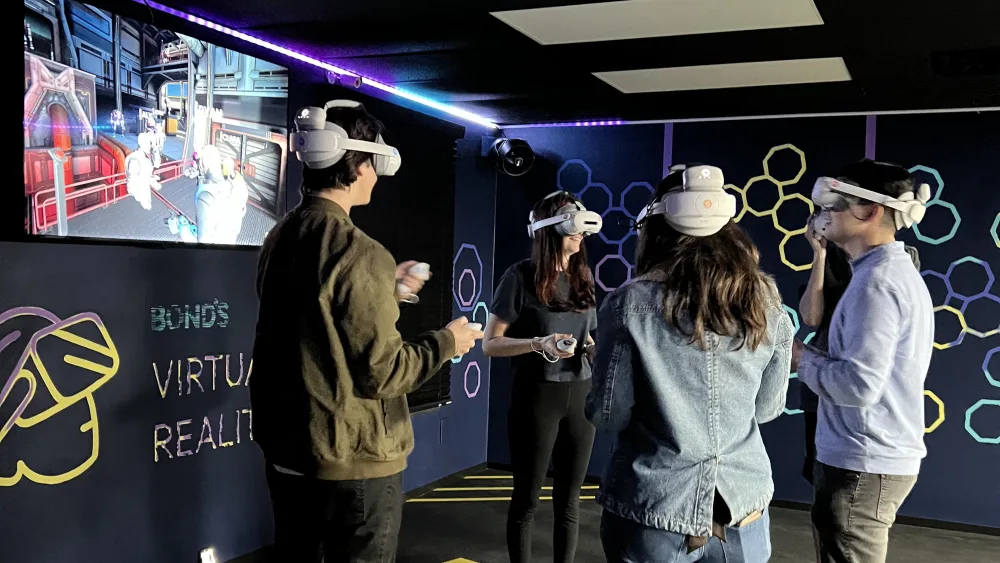
- Free-roam VR missions. Everyone is a beginner in the headset, so seniority and tenure matter less and coordination has to be earned in real time. Bond's VR Arena offers co-op missions and head-to-head games, plus VR escape-room-style games, for 2 to 6 players per arena and up to 12 across the two arenas.
- A head-to-head competition. The Game Show puts two teams of up to 8 on a stage with a live host for trivia, physical challenges and games of chance. It isn't a logic puzzle, but it suits the competitive streak.
What the first two share is interdependence: no single person can carry the whole thing, so the team has to divide labor, share findings and trust each other's calls in real time. That's the same dynamic as a hard incident response, which is why people often feel it carries back to work. For more on choosing, see escape rooms vs VR vs game shows.
How distributed engineering teams rebuild trust
Remote and hybrid work can leave technical teams functionally collaborative but relationally thin: they ship code together and barely know each other. Standups and code reviews keep the function going; they don't rebuild the relationship.
A shared challenge with an uncertain outcome can help. Solving something hard together, in person, under a clock, builds a working trust that asynchronous tools don't, and it can make the next tense production incident go a little smoother because the team already knows how each other thinks under pressure. The same research found team building's effects were strongest on how people feel about the team and how it works together.
What to expect with a tech team at Bond's
Bond's has hosted more than 9,000 team events over 11 years across 15 escape rooms in Fairfax and Arlington, and Fairfax sits minutes from I-66, Route 50 and George Mason University. You might see the quiet senior engineer who never says much in planning crack the room's core mechanic, and the manager learn more about how the team problem-solves in 60 minutes than in a quarter of standups. In our experience, the person who steps up is rarely who the org chart predicts.
That's the version of team building engineers don't roll their eyes at, because it respects how they think. For teams near Tysons or Reston, our guide to escape rooms near Tysons, McLean, Vienna and Reston covers the area. If AI is part of your team's day, read team building in the age of AI, and for more on the headset side, our VR team building experience guide. Booking is straightforward: see easy corporate team building.
Plan a team session
- Bond's Fairfax, 3949 University Dr, Fairfax, VA 22030. Nine escape rooms, two VR arenas, the Game Show and an on-site VIP conference space. (703) 270-0377.
- Bond's Arlington, 2800 Clarendon Blvd, Suite 910, Arlington, VA 22201. Six escape rooms, five minutes' walk from Clarendon Metro. (703) 884-1524.
Tell the events team about the team and how it works, and they will suggest a format. Start with the team building event page: send the quote form with your headcount and date, or email info@bondsescaperoom.com. Groups run from 6 to 150, and packages start from $325 a team.
Questions people ask
Why do engineers and IT teams hate team building?
Technical teams often have a low tolerance for forced fun and a high respect for real problem-solving. Icebreakers and trust falls feel arbitrary to them. Formats that present a real puzzle with real rules, which describes most escape rooms and VR missions, give them something to engage with.
What are the best team building activities for IT teams?
Puzzle- and systems-based formats: escape rooms where the team splits the investigation and shares findings, free-roam VR missions that need coordinated problem-solving, and a head-to-head competition like the Game Show. These reward the analytical thinking technical teams already value.
How do you build trust on a distributed engineering team?
Through shared challenge with an uncertain outcome, in person where possible. Solving a hard problem together under time pressure puts people in a situation where they have to rely on each other in real time, which code reviews and standups don't.
Where can tech companies near Reston or Tysons do team building?
Bond's Fairfax has nine escape rooms, free-roam VR and the Game Show, and Arlington has six escape rooms. See our guide to escape rooms near Tysons, McLean, Vienna and Reston for the area, and use the quote form for team events of 6 to 150.
How much does it cost to take an engineering team to Bond's?
Escape rooms are $34 a person, and VR and the Game Show are $37 a person. Team events are quoted from $325 a team, depending on headcount, how many games each person plays and whether you add catering.
More stories
 Team Building
 in the Age of AI: The One Skill Software Can't Automate
As AI takes on solo tasks, working things out with other people matters more. How escape rooms and free-roam VR give teams practice at it.
 Team Building
The VR Team Building Experience: How a Virtual Arena Shows You How Your Team Really Works
Free-roam VR team building at Bond's in Fairfax: two private arenas, up to 12 players at once, and a level playing field where nobody's job title helps.
 Team Building
Escape Rooms vs. VR vs. Game Shows: Which Team Building Format Is Right for Your Company Goal
Escape rooms, VR, or a game show for your team building event? Match the format to your goal — at Bond's in Fairfax & Arlington, VA.